


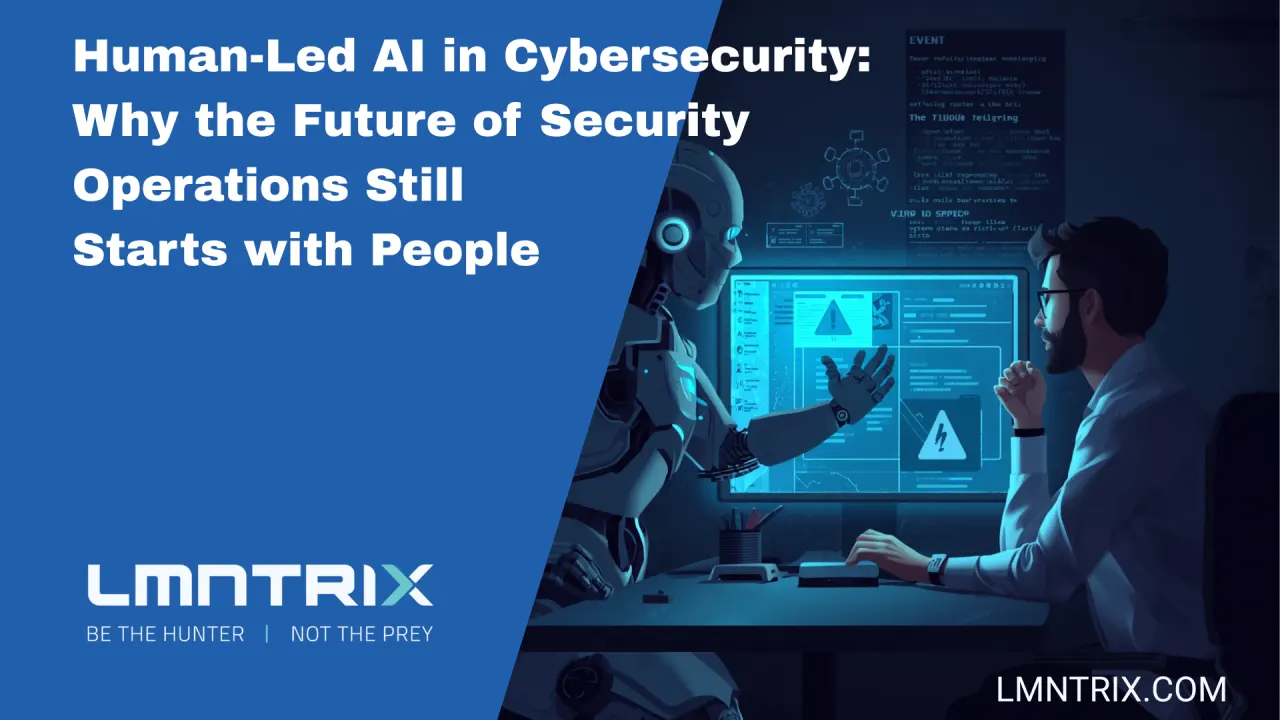
The cybersecurity industry is experiencing an unprecedented wave of artificial intelligence adoption. Security vendors are racing to embed AI into their platforms. Analysts predict autonomous security operations. Marketing campaigns promise self-defending environments capable of identifying and neutralizing threats without human intervention.
Yet despite these advancements, modern cybersecurity failures continue to occur.
The reason is surprisingly simple.
Most organizations do not suffer from a lack of security tools, telemetry, or automation. In fact, many security teams are overwhelmed by them. Security Operations Centers (SOCs) generate enormous volumes of alerts, logs, and threat data every day, often far exceeding the capacity of analysts to interpret and act upon them effectively.
The challenge facing modern cybersecurity is no longer collecting data. The challenge is transforming visibility into meaningful security outcomes.
This reality is driving a significant shift in how organizations think about artificial intelligence in cybersecurity. Rather than pursuing fully autonomous security, many forward-thinking organizations are embracing a different model: Human-Led AI.
Human-Led AI recognizes that cybersecurity is ultimately a decision-making discipline. Artificial intelligence can process information at machine speed, identify patterns across massive datasets, and automate repetitive tasks. However, people remain responsible for understanding risk, interpreting context, making strategic decisions, and defending the organization.
The future of cybersecurity is not humans versus AI. It is humans empowered by AI.
What Is Human-Led AI?
Human-Led AI is an operational philosophy that combines machine-scale intelligence with human expertise.
In this model, artificial intelligence performs the tasks it excels at:
- Processing vast quantities of telemetry
- Identifying anomalies and patterns
- Correlating events across multiple systems
- Automating repetitive workflows
- Accelerating investigations
Meanwhile, human analysts remain responsible for:
- Threat assessment
- Risk evaluation
- Strategic decision-making
- Incident leadership
- Response validation
- Business-context interpretation
Rather than replacing security professionals, AI acts as a force multiplier that enables them to operate more effectively.
This distinction is important because cybersecurity is fundamentally different from many other domains where automation can operate independently. Security decisions often involve business priorities, operational consequences, regulatory considerations, and adversarial behavior that require human judgment.
The objective of Human-Led AI is therefore not to remove people from security operations. The objective is to allow security professionals to focus on the work that humans perform best while machines handle the work that machines perform best.
The Cybersecurity Industry’s Telemetry Problem
For years, cybersecurity vendors have competed on visibility.
Organizations have invested heavily in endpoint tools, network monitoring solutions, cloud security platforms, identity systems, threat intelligence feeds, and SIEM technologies. Each deployment generates additional telemetry, often resulting in millions of security events every day.
The assumption has traditionally been that more data leads to better security.
In practice, the opposite often occurs.
As telemetry volumes increase, security teams become overwhelmed by alerts, investigations take longer, and important threats can become buried beneath operational noise.
This creates a dangerous situation where organizations possess significant visibility but limited security coverage.
Visibility alone does not stop attacks.
Security outcomes are determined by an organization’s ability to identify, understand, prioritize, and respond to threats before meaningful damage occurs.
Human-Led AI addresses this challenge by transforming raw telemetry into actionable intelligence. Instead of forcing analysts to sift through thousands of alerts, AI can prioritize activity, identify likely attack paths, and surface high-confidence threats requiring immediate attention.
The result is not simply more efficiency.
The result is improved security coverage.
Why Fully Autonomous Security Falls Short
The rise of AI has led some vendors to promote the concept of autonomous security.
The vision is appealing. Machines identify threats, make decisions, and execute responses without human involvement.
While automation undoubtedly has value, the reality of cybersecurity is far more complex.
Attackers constantly adapt their techniques. Business environments evolve. New technologies introduce unforeseen risks. Security teams must balance protection with operational continuity.
Artificial intelligence can identify unusual activity, but it cannot fully understand why that activity matters.
Consider a scenario where an AI system identifies suspicious behavior originating from a critical production server. Automated containment may appear to be the correct response. However, isolating that server could disrupt business operations, impact customers, or create unintended consequences that outweigh the immediate threat. Human expertise is still required to:
- Determining the appropriate response requires context
- Understanding business priorities
- Evaluating risk
- Ultimately, it requires accountability a human-led operation can provide.
These are inherently human responsibilities.
Cybersecurity is not simply a technical challenge. It is a business risk management discipline. Decisions made during incidents can affect revenue, reputation, operations, compliance, and customer trust.
For this reason, the most effective security operations combine automation with human oversight rather than attempting to eliminate human involvement entirely.
How Human-Led AI Improves Security Outcomes
The value of Human-Led AI becomes most apparent when examining how modern security operations function in practice.
Intelligent Alert Prioritization
Security teams routinely face alert fatigue.
AI can continuously analyze security events, identify relationships between seemingly unrelated activities, and rank incidents according to risk.
Instead of investigating thousands of alerts, analysts focus on the small number of events most likely to represent genuine threats.
This reduces noise while improving detection effectiveness.
Accelerated Investigations
Investigations often require analysts to collect data from multiple systems, correlate timelines, enrich indicators, and build attack narratives.
AI can perform much of this work automatically.
By accelerating data collection and analysis, Human-Led AI significantly reduces investigation times while allowing analysts to focus on understanding adversary behavior and determining response actions.
Threat Hunting at Scale
Threat hunting requires searching for evidence of attacker activity that may not trigger traditional alerts.
AI can identify subtle anomalies and behavioral patterns across enormous datasets that would be difficult or impossible for analysts to identify manually.
Human hunters then apply their experience, intuition, and adversarial thinking to determine whether those anomalies represent genuine threats.
Enhanced Threat Intelligence
Threat intelligence is another area where Human-Led AI delivers substantial value.
Artificial intelligence can process threat feeds, open-source intelligence, dark web activity, malware indicators, and attack telemetry at extraordinary speed.
However, intelligence only becomes valuable when it is translated into actionable insights.
Human analysts determine which threats matter to the organization, assess potential business impact, and recommend appropriate defensive measures.
Intelligence without context has limited value. Human expertise provides that context.
Human-Led AI Enables Active Defense
Perhaps the most significant advantage of Human-Led AI is its ability to support Active Defense.
Traditional security operations often operate reactively. Teams investigate alerts after controls trigger, respond to incidents after attackers establish footholds, and remediate vulnerabilities after exposure has already occurred.
Active Defense represents a fundamentally different approach.
Rather than waiting for attacks to unfold, Active Defense focuses on continuously identifying, disrupting, and reducing attacker opportunities.
Human-Led AI plays a critical role in enabling this model.
AI provides continuous visibility across the environment. It identifies suspicious activity earlier, uncovers hidden attack paths, and highlights emerging risks.
Human analysts then use those insights to proactively investigate threats, validate attacker activity, and implement defensive measures before significant damage occurs.
This combination creates a security operation that is adaptive rather than reactive. Meaning that:
- Instead of responding to alerts, organizations begin anticipating threats.
- Instead of managing noise, they focus on risk.
- Instead of measuring success through telemetry volume, they measure success through defensive effectiveness.
The Role of Human-Led AI in SOC Maturity
As organizations mature their security operations, they inevitably discover that technology alone does not create resilience.
Mature SOCs are defined by their ability to convert visibility into action. Mature SOCs have four defining features:
- They understand their attack surface.
- They measure defensive effectiveness.
- They continuously improve detection capabilities.
- They focus on operational outcomes rather than tool deployment.
Human-Led AI supports this evolution by enabling analysts to spend less time performing repetitive tasks and more time improving defensive operations.
This allows organizations to move beyond basic monitoring and toward a more sophisticated model built around operational visibility, security coverage, and continuous improvement.
In many respects, Human-Led AI is becoming a defining characteristic of modern SOC maturity.
How LMNTRIX Implements Human-Led AI
At LMNTRIX, Human-Led AI is not viewed as a feature. It is a core operational principle.
The company recognizes that effective cybersecurity cannot be achieved through automation alone. While artificial intelligence can dramatically improve the speed and scale of security operations, meaningful security outcomes still depend on human expertise.
LMNTRIX applies AI throughout the detection and response lifecycle to accelerate analysis, correlate telemetry, prioritize threats, and improve operational efficiency. Machine-driven analytics help identify suspicious activity across complex environments while reducing alert fatigue and improving investigative speed.
However, AI does not replace human judgment.
Experienced security professionals remain central to every stage of the process. Analysts validate findings, apply threat intelligence context, assess business impact, and guide response activities based on the realities of the customer’s environment.
This approach reflects LMNTRIX’s broader cybersecurity philosophy.
The company believes that cybersecurity effectiveness should be measured by security outcomes rather than telemetry volume.
More alerts do not necessarily create better security.
More data does not automatically improve visibility.
Instead, organizations require meaningful security coverage, operational visibility, and the ability to actively defend against modern threats.
By combining Human-Led AI, Active Defense methodologies, hyper-converged XDR visibility, and experienced security professionals, LMNTRIX seeks to help organizations improve their real-world defensive capabilities rather than simply increase the volume of information available to security teams.
As attackers increasingly adopt AI to accelerate phishing, malware development, reconnaissance, and post-compromise activities, this approach becomes even more important.
Defending against machine-speed threats requires machine-speed intelligence.
Defeating those threats still requires human expertise.
The Future of Cybersecurity Is Human-Led
The cybersecurity industry has largely moved beyond whether artificial intelligence belongs in security operations.
The more important question is how it should be used.
Organizations that pursue automation without oversight risk creating faster ways to make poor decisions. Organizations that rely solely on human effort struggle to keep pace with the scale and speed of modern threats.
The most effective path forward combines the strengths of both.
Artificial intelligence delivers speed, scale, automation, and visibility.
Human experts provide context, accountability, creativity, and strategic decision-making.
Together, they create a more resilient security operation than either could achieve independently.
The future of cybersecurity will not be defined by who deploys the most AI.
It will be defined by who combines machine intelligence with human expertise most effectively.
In an era of escalating threats, expanding attack surfaces, and AI-enabled adversaries, Human-Led AI represents more than a technology strategy.
It represents the next evolution of modern security operations.