
Agentic AI, Attacker and Defender
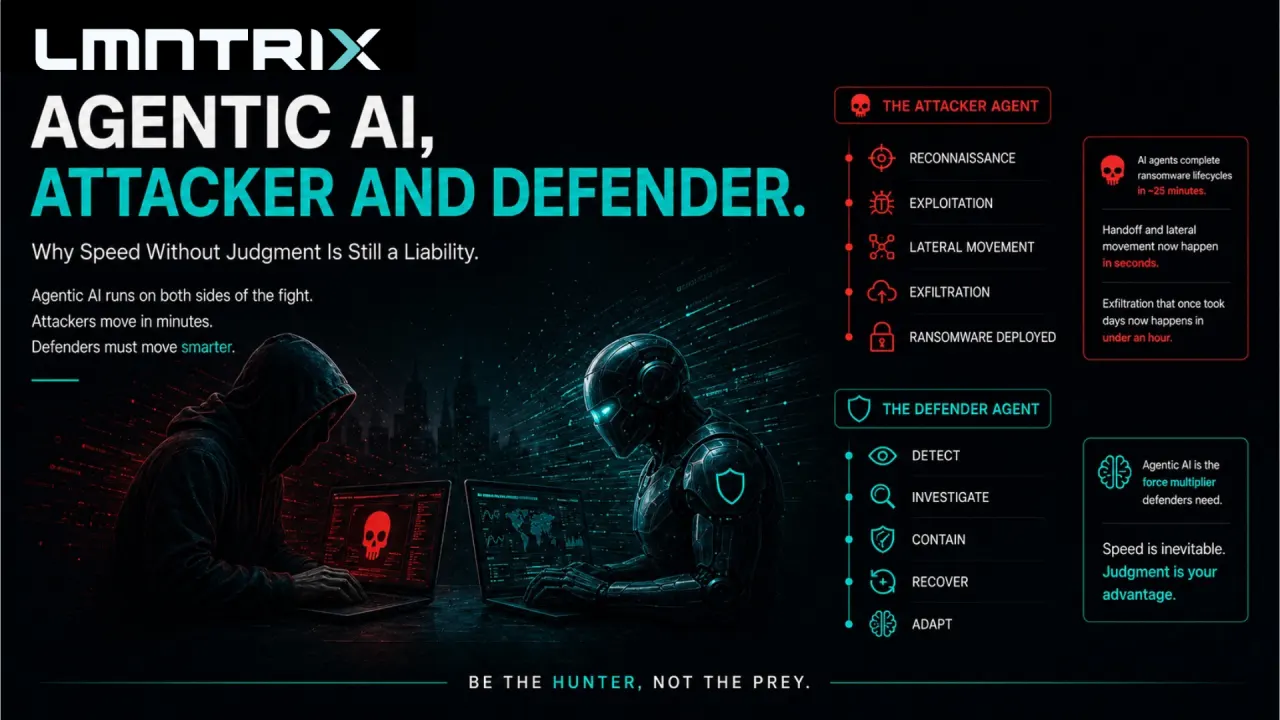
Why Speed Without Judgment Is Still a Liability, An LMNTRIX Perspective
For two years the industry debated whether AI would change cybersecurity. That debate is over. Agentic AI, systems that reason, plan, act, and adapt without a human directing every step, is now running on both sides of the fight, frequently built from the same underlying techniques. One leading analyst firm’s 2026 cybersecurity trends report puts agentic AI oversight at the very top of the list, warning that agentic AI adoption among employees and developers is quietly expanding the attack surface faster than most security teams can map it. Other industry research frames the same shift more bluntly, describing AI as simultaneously a shield and a sword for the industry it serves. LMNTRIX would put it more directly still: the same reasoning loop that finds a gap for a red team can find it for a ransomware crew, and the vendors selling “autonomous AI defense” are, more often than not, selling you half of that same technology, minus the part that decides what to do when it’s right.
The Hunter Wearing an Attacker’s Face
Agentic pentesting, AI systems that plan, execute, observe results, and adjust tactics without a human approving each step, has moved from research curiosity to production reality in under three years. One autonomous offensive-security agent now sits at the top of a major bug-bounty platform’s global leaderboard with more than a thousand validated vulnerability submissions, a milestone that made international business press because a machine had, for the first time, out-competed elite human researchers at their own game. The commercial pentesting market has followed the same arc: platforms now market continuous, adaptive testing that runs around the clock against production environments, rather than a scheduled two-week engagement once a year.
The same architecture, unsurprisingly, works just as well for attackers who never ask permission. One threat-research team built an Agentic AI Attack Framework to simulate autonomous ransomware campaigns and found that an agent could complete an entire ransomware lifecycle, reconnaissance through exfiltration, in roughly 25 minutes. The same research traces mean time to exfiltrate falling from about nine days in 2021 to roughly two days in 2024, with a growing share of real incidents completing exfiltration in under an hour. Security researchers have already documented what they assess to be the first fully agentic ransomware operation observed in the wild, an LLM agent that autonomously exploited a known vulnerability in Langflow for initial access as part of a campaign coordinated with custom credential-cracking infrastructure. A major bug-bounty platform’s 2025 hacker-powered security data shows the same curve from the disclosure side: AI-related vulnerability reports rose 210% year over year, prompt-injection reports rose 540%, and the platform logged more than 560 reports attributed to autonomous agents. Threat-intelligence research from 2026 tells the story from yet another angle: attacker handoff and lateral-movement time, once measured in hours, is now regularly measured in tens of seconds.
Everyone Is Selling You the Other Half of the Same Technology
The defense industry’s answer has largely been to sell the mirror image of the same capability back to the buyer. Some SOC platforms have built specialized AI agents directly into their offerings, positioned to triage, investigate, and respond at what vendors call agentic speed. Other network security vendors have introduced open-source secure-agent frameworks, explicitly framed around helping defenders outpace adversaries who are themselves moving at machine speed. One endpoint-security vendor’s 2026 threat report puts average breakout time at 29 minutes, down 65% year over year, with the fastest recorded case clocked at 27 seconds from initial foothold to lateral movement. Every one of these vendors is right that the clock has changed. Where the marketing gets ahead of the evidence is in implying that an autonomous agent, on its own, is an adequate answer to an autonomous attacker. The same analyst firm’s 2026 trends report flags a related, quieter problem: as AI agents proliferate, traditional identity and access management wasn’t built for machine actors, and credential automation for agents is becoming a new governance gap in its own right.
This pattern isn’t limited to the household names. A wave of smaller vendors has built entire go-to-market strategies around the promise of fully autonomous defense, AI that detects, decides, and acts without waiting on a human, pitched as the only way to match an attacker who no longer waits either. It’s a seductive pitch, and it isn’t wrong that machine-speed reconnaissance needs a machine-speed response layer underneath it. Where it becomes a liability is the next step: treating detection speed and response authority as the same problem, when the research above shows they demonstrably are not. An agent that can find a gap in 25 minutes and an agent that should be trusted to unilaterally contain, remediate, or shut down production systems in that same 25 minutes are two very different claims, and conflating them is exactly the kind of “cyber sizzle” that gets sold ahead of the operational evidence to back it up.
The Autonomy Trap
The research on human-in-the-loop oversight is not encouraging for a fully hands-off defensive model. A widely referenced 2026 analysis on AI agent oversight describes what happens once human approval checkpoints stop being a considered decision and become a reflex; teams begin waving through agent actions simply because prompt volume makes genuine review impossible in practice. Separate research on human-in-the-loop breakdown at scale makes a related point: because agents can act at runtime and keep moving without a person confirming each step, the assumption that a human will reliably intervene when it matters tends to fail precisely when the stakes are highest. None of this means human oversight is obsolete. It means oversight has to be designed around what humans are actually good at, judgment, context, and accountability, rather than bolted on as an afterthought to an otherwise autonomous pipeline.
This is also, not coincidentally, the same failure mode alert fatigue has produced for a decade. Industry research on AI-driven SOC adoption cites uninvestigated alert rates as high as 40% under legacy tooling. Separate research finds that only 11% of security professionals fully trust AI for critical security tasks even as adoption accelerates around them, a trust gap that a faster, more autonomous alert engine does nothing to close. Replacing a flood of unvalidated machine alerts with a flood of unvalidated machine actions doesn’t solve the underlying trust problem. It just moves it further downstream, into production, where the cost of being wrong is higher.
Even some of that same forward-looking industry research lands closer to LMNTRIX’s position than the marketing built on top of it might suggest: security predictions for 2026 conclude that the next era of the SOC belongs to the humans who bring context, judgment, and creativity to every mission, with AI agents operating as partners rather than replacements.
Human-Validated, Not Just AI-Flagged
This is where LMNTRIX’s model diverges from the “autonomous AI defense” pitch by design, not by limitation. LMNTRIX’s Active Defense architecture runs AI-driven detection continuously; more than 450 automated, continuous threat hunts across thirteen vectors simultaneously, correlated across endpoint, network, identity, cloud, and deception telemetry. But every validated incident that reaches a client has passed through a human analyst first, at a false-positive rate below 0.0001%. The AI finds the gap faster than any team of humans could scan for it manually; the Cyber Defense Center decides what happens next, and remediation is typically complete within 30 minutes of confirmed detection, rather than the hours to days containment typically takes.
Speed accelerates the hunt. Judgment governs the response. That is not a hedge against AI; it is the only architecture that survives contact with an adversary who is now using the same speed against defenders, because the moment detection and action collapse into a single autonomous loop with no validating human in it, an organization inherits every failure mode the research above shows attackers are already exploiting on the other side of the fence.
Autonomous-defense marketing is appealing precisely because it promises to remove the hardest part of security: judgment under uncertainty. But judgment doesn’t scale by adding compute; it scales by putting trained analysts in the loop at the moment that matters, with AI doing the reconnaissance work at a pace no human team could match alone. AI can find the gap faster than ever. That is exactly why it can’t be the last set of eyes on it.
Heading into next year, the organizations that get hurt won’t be the ones that adopted agentic AI too slowly. They’ll be the ones that let an unvalidated agent make the call a trained analyst should have made, on either side of the fight. LMNTRIX’s bet is that the winning architecture in an agentic-AI arms race isn’t the fastest autonomous loop. It’s the fastest loop with a human still closing it.