
Alert Fatigue and the SOC Noise Crisis: Why More Alerts Isn’t More Security
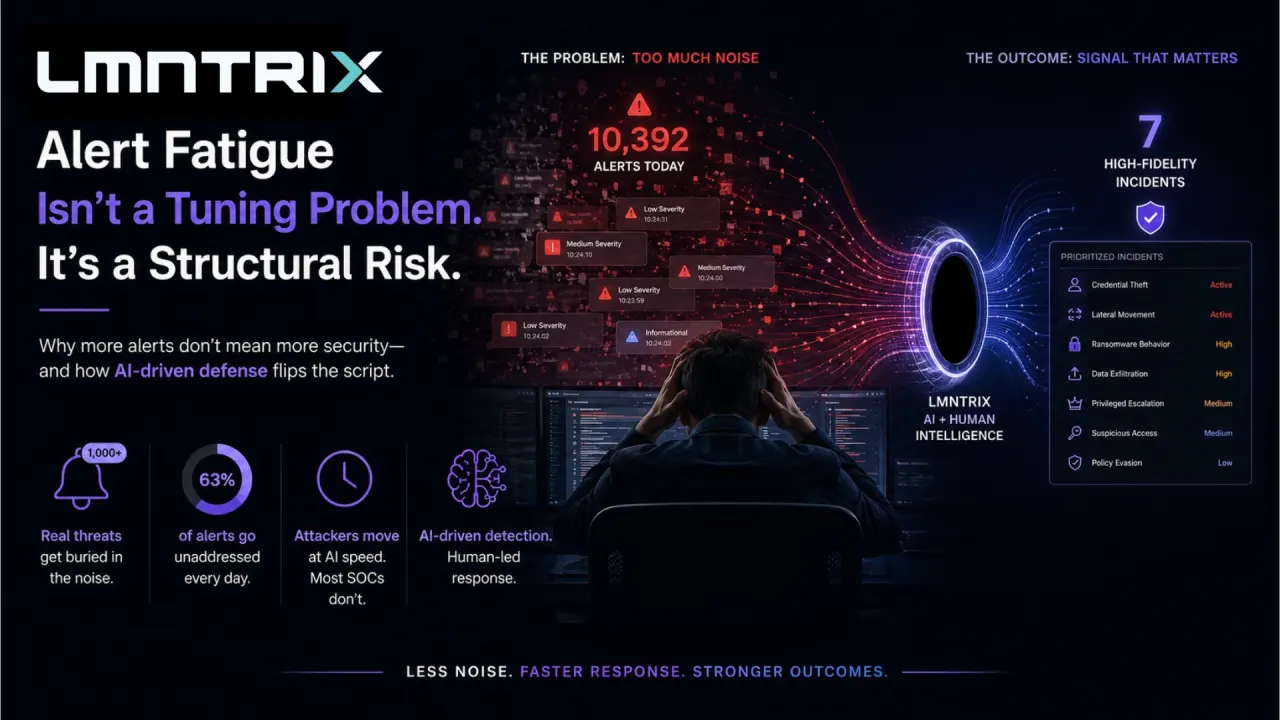
Every CISO has lived this moment: a genuine intrusion sits in the queue, indistinguishable from the thousands of alerts around it, until someone outside the company points it out first.
That isn’t a hypothetical. It’s the default outcome of how most security operations centers are built today.
The math doesn’t work anymore
The enterprise SOC now sits under an alert volume that has stopped being a tuning problem and started being a structural one. Estimates vary by source and org size, but they land in the same place: enterprise SOCs face daily alert volumes ranging from roughly 1,000 to well over 10,000, depending on tool sprawl and company size, according to research from Vectra AI and a Forrester-sourced analysis published by UnderDefense, the latter putting the enterprise SOC average at 11,000 alerts a day against roughly 22 per analyst that actually warrant investigation.
The consequence isn’t a backlog; it’s a filter that quietly drops real threats. Vectra’s research found that 63% of daily alerts go unaddressed, and separate data cited in the same report shows 42% of alerts are never investigated at all. The 2025 SANS Detection and Response Survey found that 73% of security teams name false positives as their single biggest detection challenge, and research from Cybersecurity Insiders puts the share of organizations citing alert fatigue as a top SOC concern at 76%, figures corroborated across multiple 2026 industry write-ups, including Vectra’s alert fatigue research.
This is what happens when a SOC is built to collect signal instead of to hunt threats. Volume becomes camouflage. The one alert that matters gets buried under the nine hundred that don’t, and an analyst three shifts deep into a “probably benign” pattern is the last line of defense standing between a phishing email and a boardroom disclosure.
The clock is now working against you
Alert fatigue used to be an operational inconvenience. It’s now a timing problem, and timing is the one variable attackers have started to win.
IBM’s 2025 Cost of a Data Breach Report found that the average breach lifecycle, time to identify plus time to contain, sits at 241 days globally. That’s the lowest figure in nine years, but it’s still the better part of a year of unauthorized presence in an environment before it’s fully resolved. The same report found that organizations using AI and automation extensively identified and contained breaches 80 days faster and saved close to $1.9 million per breach compared to those that didn’t. Speed isn’t a nice-to-have metric anymore; it’s the entire cost equation.
Meanwhile, the other side of the fight has stopped waiting on analysts to catch up. Booz Allen’s “When Cyberattacks Happen at AI Speed” report documents threat actors adopting AI faster than defenders, automating reconnaissance, persistence, and scaling, while most SOCs still run on human-paced triage, escalation, and approval chains built for a slower era. Palo Alto Networks’ 2026 Unit 42 Global Incident Response Report, summarized by Novee Security, found that median breakout time, the point where an attacker moves from initial foothold to lateral movement, compressed roughly fourfold year over year, from nearly five hours to just over one.
ISACA’s 2026 cybersecurity trends analysis frames the imbalance precisely: AI-powered tools can now run offensive actions with more speed and precision than a human operator, but understanding an environment’s scope, weighing unknown variables, and establishing context still depends on human reasoning. Attackers no longer need that reasoning step to move fast. Most defenders still do, and a SOC drowning in unfiltered volume has even less bandwidth to apply it where it counts.
Splunk’s research into 2026 cybersecurity trends names the resulting bind directly: rapidly evolving threats, increasingly complex tech environments, mounting regulatory pressure, and alert fatigue are now compounding challenges rather than separate ones. A SOC that can’t cut through its own noise doesn’t just move slower on real incidents; it moves slower while the window to catch them is shrinking.
Why “more tools” made this worse, not better
Most organizations responded to rising threat volume the way the market told them to: buy another point product. Endpoint here, network there, a cloud security tool bolted on, an identity layer stapled to the SIEM, each one generating its own alerts, in its own console, with its own severity logic and none of the others’ context.
That’s not a security stack; it’s fifty consoles nobody has time to correlate by hand. Every additional tool without native correlation adds another stream of noise an analyst has to reconcile manually before they can even start investigating, and reconciliation isn’t detection. It’s overhead disguised as coverage.
This is the exact failure pattern our founder, Carlo Minassian, spent three years documenting after globalizing his first managed security company. Engaging with hundreds of organizations, many spending millions a year on security, he found the same root cause behind breach after breach: noise. Not a lack of tools. Not a lack of budget. A flood of alerts with no reliable way to tell the real incident from the false positive, and security teams that had been quietly trained by their own tooling to assume the next alert was nothing.
That’s the thesis LMNTRIX was built to reverse. Not “more visibility,” but fewer, validated incidents, investigated by humans before they ever reach a client, so a CISO’s team spends its time hunting instead of triaging.
What actually closes the gap
Tuning rules and hiring more analysts both hit a ceiling fast: rule tuning chips at the edges of a volume problem, and analyst headcount can’t scale linearly against a threat landscape that’s compounding. Closing the gap requires changing what generates an alert in the first place, and what happens to it after.
Correlate before you alert. A converged platform that unifies endpoint, network, cloud, mobile, identity, and deception telemetry into one console can surface a single high-fidelity incident instead of five disconnected alerts from five disconnected tools, cutting the reconciliation tax analysts pay before investigation even starts.
Validate before it reaches the client. Automated triage narrows volume; it doesn’t replace judgment. Every incident still needs a human who can assess scope, weigh unknown variables, and apply context the way ISACA describes, the exact reasoning step that’s hardest to compress and easiest to skip when a team is buried.
Put deception to work. Decoys and breadcrumbs across the environment turn attacker reconnaissance into an early, high-confidence detection trigger, a signal generated by the attacker’s own behavior, not by another log line competing for attention in an already-flooded queue.
Measure the metric that matters. Alert volume trending down is not the goal; time from confirmed detection to surgical containment is. That’s the number that determines whether a breach costs $3.6M or $5.5M under IBM’s own findings, and it’s the number every SOC investment should be judged against.
How LMNTRIX applies this: Active Defense, not another console
Every principle above only works if the alert generating it is trustworthy in the first place. Most MDR and XDR providers can’t guarantee that, because they inherit their detections from the same controls that already missed the threat. If CrowdStrike, Palo Alto, Microsoft, Zscaler, or Proofpoint don’t flag something, the MDR sitting downstream of those tools doesn’t flag it either; noise and blind spots both pass straight through.
We built LMNTRIX to operate on the opposite assumption: existing controls are being bypassed continuously, and someone has to be watching from behind them to prove it. That’s Active Defense, and it’s the mechanism that actually drives the noise down instead of just repackaging it.
Independent telemetry, not log aggregation. LMNTRIX doesn’t ingest logs from a customer’s incumbent stack and re-alert on what it already reported. We deploy our own endpoint, network, identity, cloud, deception, and OT sensors behind the existing controls, with our own detection logic. That means the noise a CISO’s team already fights from their point products never becomes LMNTRIX noise; our signal is independent by design, not filtered from someone else’s.
Nine hunting vectors, run continuously, not reactively. 450+ automated threat hunts run across endpoint, network, identity, cloud, email, deception, OT, packets, and threat intelligence simultaneously, backed by human-led, hypothesis-driven hunting at Hunting Maturity Model Level 4. The hunts are structured around what dormant, low-signal adversary tradecraft looks like, the opposite of a rules engine waiting for a signature match to fire another ticket.
Deception as a zero-false-positive tripwire. A decoy has no legitimate business reason to be touched. When one is, that’s confirmed adversary activity, not a probability score, not a “medium confidence” flag competing with nine hundred other alerts for attention. It’s one of the few detection mechanisms that produces a real signal with no noise attached to it.
Human validation on every alert, before a client ever sees it. Every detection is reviewed by an analyst before it’s surfaced, holding LMNTRIX’s reported false-positive rate under 0.0001%. That’s the practical definition of ending alert fatigue for a client’s own team: they stop receiving alerts and start receiving confirmed incidents.
One converged platform instead of a Frankenstein stack. Thirteen operationalized modules, including NDR, EDR, full packet capture, mobile, cloud/CNAPP, threat intelligence, deception, dark web recon, identity, SIEM, attack validation, OT/SCADA/IoT, and email security, run in a single telemetry fabric with one investigation workflow and one accountable SOC. That’s the direct fix for the “fifty consoles nobody has time to correlate” problem described above, because there’s no reconciliation tax to pay in the first place.
Outcome ownership, not a recommendation back to the client. Containment, remediation, forensics, and recovery are performed by LMNTRIX’s SOC, not handed back to an already-stretched internal team as another action item. Unlimited DFIR, including memory and disk forensics, malware reversing, and adversary tradecraft reconstruction, is included in the subscription rather than metered by the hour, unlike competing engagements.LMNTRIX cites IDC’s 2024 MarketScape for Worldwide Emerging MDR Services, where LMNTRIX was named a Leader, as calling out unlimited containment, remediation, and proactive hunting hours as a meaningful differentiator for exactly this reason; it’s worth verifying against IDC’s original report rather than any vendor restatement of it, including this one.
None of this displaces a client’s existing investment. Existing tools stay in place as the front line. LMNTRIX operates behind them, and every validated incident we surface is, by definition, something that front line already missed, proof that noise reduction and detection coverage aren’t a trade-off; they’re the same problem solved the same way.
Proof over promises
We run a structured 30-day proof of concept (Deploy, Baseline, Hunt, Validate, Executive Closeout) with our SOC hunting from day one, and we encourage prospects to run a penetration test during the trial window. The result is usually the same: organizations that have already invested in every Gartner Magic Quadrant leader together with an expensive internal SOC still see 20–50 validated threats surface that their existing stack and staff missed entirely.
That’s not a sales pitch a CISO has to take on faith. It’s their own environment’s data, gathered in 30 days, showing exactly where the noise was hiding a real gap.
The bottom line for CISOs
Alert fatigue isn’t a symptom of a SOC that needs better morale policies or a longer on-call rotation. It’s the operational condition created when alert volume outpaces investigation capacity, and in 2026, that gap is widening from both directions at once: attackers moving at machine speed, and most SOCs still triaging at human speed through tools that were never built to talk to each other.
The organizations closing that gap aren’t the ones buying another dashboard. They’re the ones treating noise itself as the threat: correlating instead of collecting, validating instead of flagging, and measuring speed-to-containment instead of alert counts. That’s not a new idea. It’s the one this company was founded on.