- PlatformCore Detection & ResponseEDRAdvanced endpoint detection and response with deep visibility, autonomous containment, and analyst-driven investigationNDRNetwork detection and response powered by full packet capture, session reconstruction, and AI-driven anomaly detection.CloudUnified cloud protection across workloads, identities, and SaaS apps, combining visibility with runtime defense.MobileEndpoint security for iOS and Android, detecting malicious apps, phishing attempts, and device-level exploits.IoT/OTCritical asset visibility and threat detection for industrial and IoT environments—without downtime or blind spots.Human Threat Actor CoverageIntelligenceGlobal threat intelligence aggregated from 300+ sources, mapped to your environment for real-time detection and context.Attack ValidationAutomated adversarial validation to confirm detections, test controls, and prioritize real threats over noise.DeceiveDeception technology that lures attackers into decoy environments, revealing tactics before damage is done.IdentityIdentity threat detection and protection with real-time monitoring of Active Directory, Entra ID, and credentials.Post-Breach Forensics & IRPacketsFull-fidelity network forensics with packet capture, file extraction, and retrospective analysis.SIEMCentralized log management and correlation across all telemetry sources for complete security visibility.ReconContinuous adversarial exposure management—simulating attacker reconnaissance to surface hidden weaknesses.
- MDR
- Why LMNTRIX
- Active Defense
- Use CasesBusiness Use CasesReliable & Thorough CybersecurityElevate Security OperationsCross Product CorrelationTech Use CasesCloud Security SimplifiedOptimizing SIEM Security with Next-Gen Detection ToolsAchieve Excellence in Security OperationsComprehensive MITRE ATT&CK Coverage for All StagesEnvironment Use CasesMDR for AWS Cloud Security – 24/7 Detection & ResponseManaged Detection & Response for Google Cloud SecurityAdvanced Microsoft MDR Security for Threat Defense
- LMNTRIX vs the CompetitionLMNTRIX vs other vendorsvs. CrowdStrikeOverhyped, Overpriced & Always Breachedvs. SentinelOneLimited protection, unable to prevent breachesvs. MicrosoftComplex operations increase TCOvs. Palo Alto NetworksDifficult to implement, operate, & maintainvs. SophosOverpriced and Overcomplicatedvs. Trend MicroLimited to own ecosystem & threat of DevOps interruptionsvs. DarktraceOver-promises with flashy AI marketing but always under-deliversvs. other MDRsSlow MDRs that miss threats and leave you to fix the damage
- Ask LISA
LMNTRIX AAV
Continuously Simulate Real-World Attacks. Stay One Step Ahead.
Validate your defenses with safe, scalable attack simulations that reproduce real adversary behavior, expose exploitable paths, test security controls, and prove that remediation works.
A 24/7 Red Team You Can Run on Demand
Move beyond point-in-time vulnerability lists by safely demonstrating how weaknesses can be chained into real business impact.
Reconnaissance & Service Discovery
- Perform internal and external host discovery and service enumeration.
- Assess exposed infrastructure, credentials, and authentication surfaces.
- Use OSINT and attacker-style discovery to identify viable entry paths.
Key Benefits
Attack. Measure.
Improve. Repeat.
A repeatable validation cycle shows where defenses fail, what the failure means, and whether remediation is effective.


- 01Define ScopeSelect internal, external, cloud, or specific asset ranges and establish safe test boundaries.
- 02DeployUse a cloud-managed agent or supported deployment model with minimal setup.
- 03DiscoverEnumerate hosts, services, credentials, and reachable attack surfaces.
- 04ExploitSafely test vulnerabilities, privileges, lateral movement, and exfiltration paths.
- 05CorrelateCompare simulated behavior with SIEM, EDR, firewall, and SOC detection workflows.
- 06Remediate & Re-TestPrioritize fixes, verify closure, and trend posture over time.
- 01. Define Scope — Select internal, external, cloud, or specific asset ranges and establish safe test boundaries.
- 02. Deploy — Use a cloud-managed agent or supported deployment model with minimal setup.
- 03. Discover — Enumerate hosts, services, credentials, and reachable attack surfaces.
- 04. Exploit — Safely test vulnerabilities, privileges, lateral movement, and exfiltration paths.
- 05. Correlate — Compare simulated behavior with SIEM, EDR, firewall, and SOC detection workflows.
- 06. Remediate & Re-Test — Prioritize fixes, verify closure, and trend posture over time.
Replace Assumptions with Proof
LMNTRIX AAV automates repeatable validation across small and large environments and produces remediation-focused evidence quickly.
Lower Cost than Manual Point-in-Time Testing
Executive and Technical Reporting
Configurable Testing Scale
-
Scope
-
Simulate
-
Validate
-
Remediate
-
Re-Test
Questions.
Clear answers.
Answers about automated attack validation, safe exploitation, reporting, and scheduling.
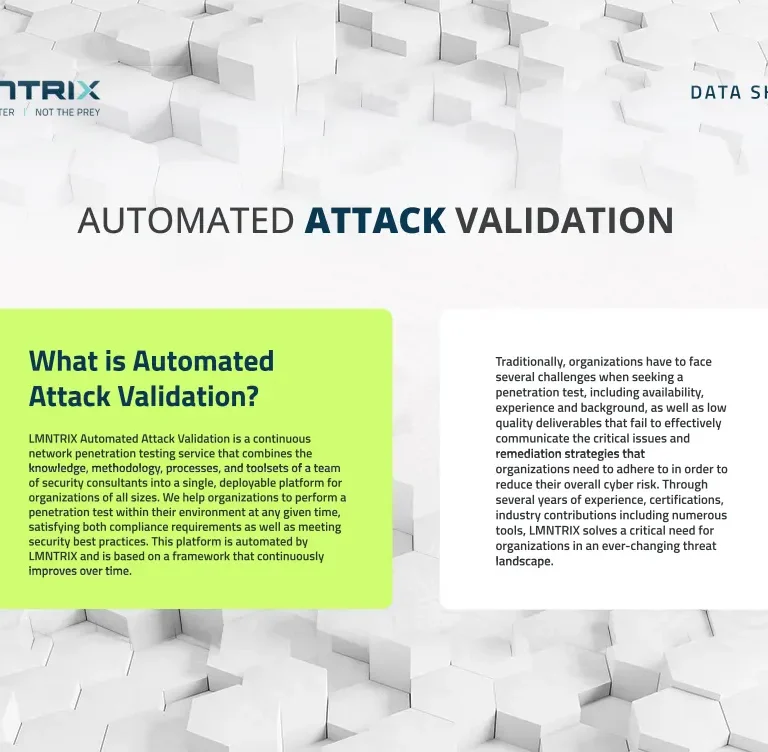
LMNTRIX AAV is an XDR subscription module that automates the technical stages of a network penetration test, including discovery, exploitation, post-exploitation, privilege escalation, lateral movement, and reporting.
A vulnerability assessment identifies weaknesses. AAV safely attempts to exploit and chain them, helping teams understand whether a weakness can lead to deeper access or data exposure.
Yes. LMNTRIX AAV can validate both internal and external environments and can also assess supported cloud infrastructure.
AAV provides configurable scope and intensity and uses controlled testing methods. Organizations should still schedule higher-risk validation for appropriate windows and environments.
Yes. Tests can run on demand or recur weekly, monthly, quarterly, or on another agreed schedule.
It provides faster, repeatable technical validation, while manual specialists remain valuable for complex web, API, social-engineering, and creative attack scenarios. The two approaches can complement each other.