
Autonomous AI Alone Won’t Stop a Breach: Why Human-Validated Detection Still Wins
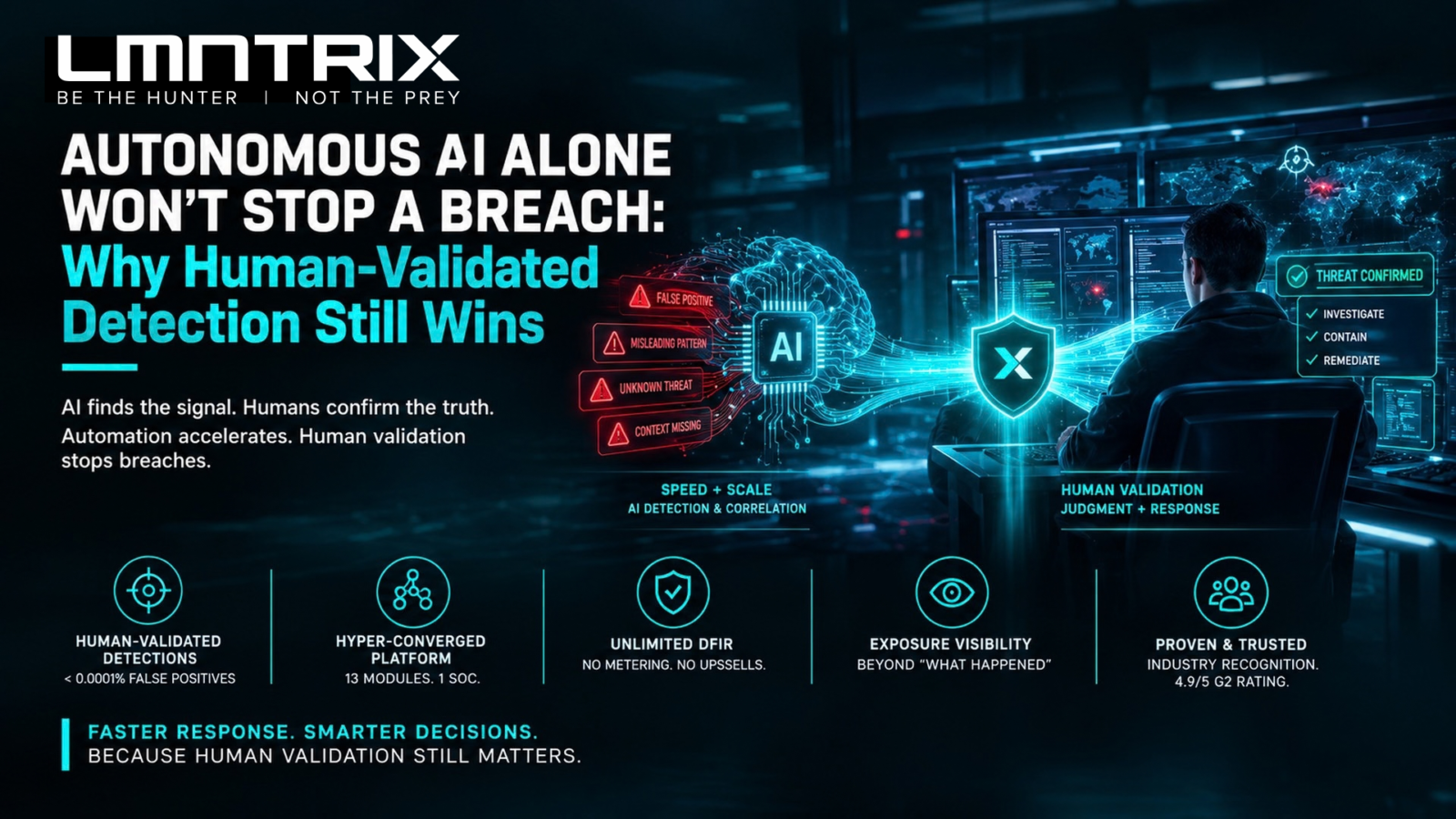
Walk through the marketing of almost any AI-native endpoint or XDR vendor today and you’ll find the same promise: security at “machine speed,” autonomous remediation, and a SOC that runs itself. It’s a compelling pitch, and it’s easy to see why buyers are drawn to it; fewer analysts, faster response, less human bottleneck.
It’s also, on its own, an incomplete answer to the problem security teams actually have.
The autonomous-AI pitch, and its blind spot
The autonomous-AI category has built its entire narrative around speed and independence from human judgment: let the model detect, correlate, and respond, and let the human step in only when something truly novel appears. For a narrow set of well-understood, signature-adjacent threats, that works well. But it also invites a fair question that this generation of vendors hasn’t fully answered: what happens when the model is wrong, or when an adversary specifically designs their tradecraft to look like nothing the model has seen before?
Security leaders have started to push back on autonomy-as-marketing for exactly this reason. Automation that isn’t checked by a human validator doesn’t eliminate false positives and alert fatigue; it just moves the point of failure from “too many alerts for a human to review” to “an automated system making containment decisions no one verified.” Neither outcome is actually acceptable when the cost of a missed or mishandled detection is a full-blown breach.
Automation should accelerate defenders, not replace them
LMNTRIX’s position on this is a narrow one, deliberately: automation is a force multiplier for human analysts, not a substitute for them. Every alert LMNTRIX’s platform surfaces is validated by a human analyst before it becomes an incident, which is a large part of why the company can stand behind a false-positive rate below 0.0001%, a number that would be functionally impossible to sustain if a model, rather than a person, were the last checkpoint before action.
That validation layer sits on top of 450+ automated, continuous threat hunts running simultaneously across nine vectors; endpoint, network, identity, cloud, email, deception, OT, packet capture, and threat intelligence; plus human-led, hypothesis-driven hunting at Hunting Maturity Model Level 4. The automation does the heavy lifting of surfacing anomalies at scale; the humans do the job that still requires judgment: deciding what’s actually a threat and what to do about it.
Hyper-converged, not “autonomous and siloed”
Autonomous-AI platforms tend to be architected around a single control point, most commonly the endpoint, with everything else bolted on or left to integrations. LMNTRIX takes the opposite approach: 13 fully operationalized modules (NDR, EDR, full packet capture, mobile, cloud/CNAPP, threat intelligence, deception, dark web reconnaissance, identity, SIEM, attack validation, OT/SCADA/IoT, and email security) run in a single telemetry fabric, with one investigation workflow and one accountable SOC team behind all of it. That matters because the most dangerous adversary activity rarely announces itself at a single control point; it shows up as a pattern across several of them at once, which is exactly what a converged architecture is built to catch and a single-agent one is built to miss.
Unlimited DFIR, not metered, not upsold
When an incident does happen, the response shouldn’t come with a bill for every hour of forensic work. LMNTRIX includes unlimited digital forensics and incident response; memory analysis, disk forensics, malware reversing, and full adversary tradecraft reconstruction; inside every subscription, at no additional cost. IDC’s 2024 MarketScape for Worldwide Emerging MDR Services specifically called out unlimited containment, remediation, and DFIR hours as a meaningful differentiator for clients evaluating MDR providers, and it’s one of the clearest, most concrete ways LMNTRIX’s model diverges from vendors that treat incident response as a premium, metered add-on.
Exposure visibility beyond “what happened”
Most platforms, autonomous or otherwise, are built to answer one question: what just happened? LMNTRIX’s Vanguard Security Architecture Command Center is built to answer a different one: where are we exposed right now? It gives security leaders a continuously updated view of every security investment, control gap ranked by risk, and technology rationalization opportunity across their environment, a category of visibility that a purely detection-and-response-focused, autonomous architecture doesn’t attempt to provide.
The credibility behind the claims
None of this is a marketing narrative built in isolation. LMNTRIX has been named a Leader in IDC’s MarketScape for Worldwide Emerging MDR Services, recognized among the top 20 global vendors in Gartner’s 2024 Market Guide for MDR, and holds a 4.9-out-of-5 rating across verified reviews on G2; with reviewers consistently pointing to responsive, human-led monitoring rather than “set it and forget it” automation as the reason they stay. The company has done this as a privately held, founder-led business with no outside investor pressure shaping its product roadmap, under CEO Carlo Minassian, who previously built and scaled Earthwave into a Gartner-recognized MSSP before it was acquired by NTT.
The takeaway for buyers
Autonomous, machine-speed response is a genuinely useful capability, right up until the moment a threat doesn’t match the pattern the model was trained to expect. That’s precisely the moment human-validated, hyper-converged, cross-domain detection earns its place. The question worth asking any AI-native vendor isn’t how fast their model responds. It’s who, or what, is checking the model’s work before it acts on your environment.
Evaluating MDR/XDR providers? Ask any vendor promising full autonomy one direct question: what percentage of their “detections” are validated by a human before becoming an action taken on your network; and what’s included, versus billed separately, when a real incident hits.