
When the Network Fights Back: Pairing NDR with Deception for Near-Zero-False-Positive Lateral Movement Alerts
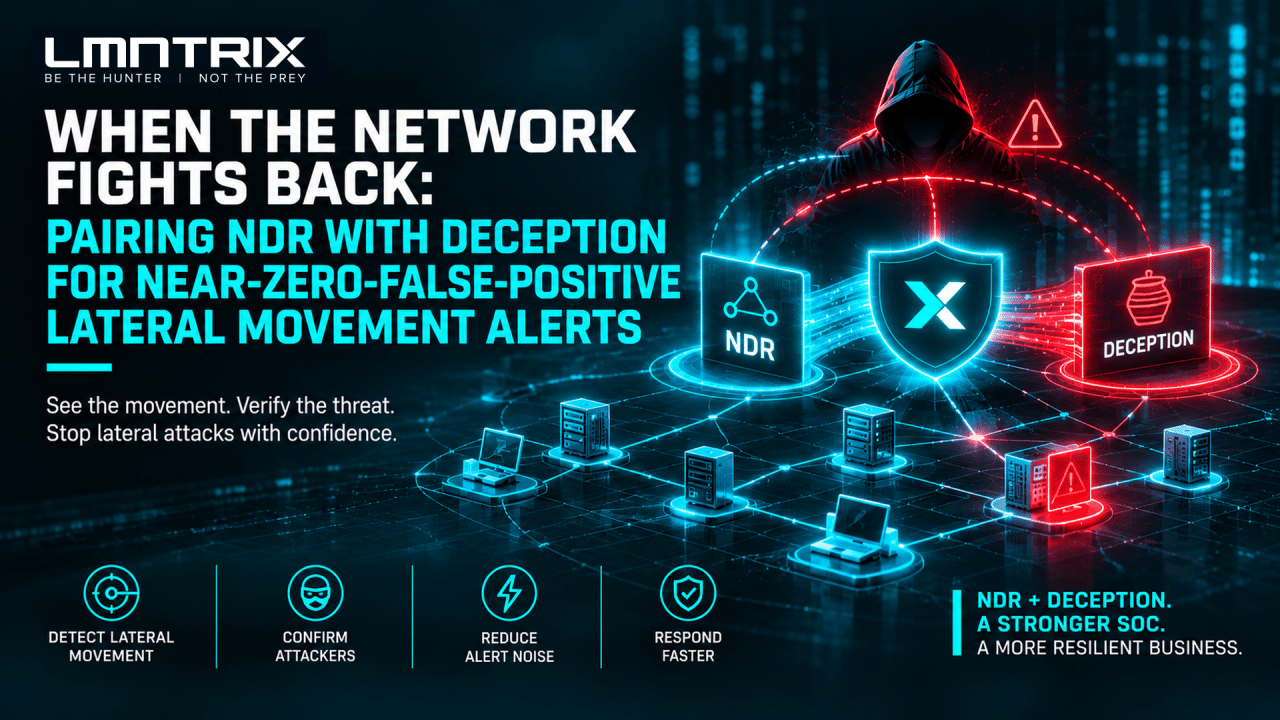
NDR sees everything, and that is the problem
Network detection and response (NDR) watches the traffic between your systems. It sees an attacker move from a laptop to a file server, from a file server to a domain controller, from a domain controller to the backups. Endpoint agents miss much of that movement. NDR does not.
But NDR also sees your IT team doing exactly the same things for legitimate reasons. Admins use RDP. Backup jobs touch every server. Vulnerability scanners map the whole network every week. To a network sensor, an attacker and a busy sysadmin can look alike.
Deception technology solves that ambiguity. Pair NDR and deception and a suspicious connection becomes something better: a connection to an asset no legitimate user has any reason to touch.
NDR and deception, in one sentence: NDR shows you every path an attacker could be taking across the network; deception tells you, with certainty, which of those paths is an attacker.
Why NDR alone gets noisy
NDR detects by comparing traffic against a baseline of normal behaviour. That works well for blatant activity: a host suddenly talking to 400 others, a beacon to an unknown domain every 60 seconds. It struggles with the quiet middle of an intrusion, where attackers deliberately blend in:
- Valid credentials over standard protocols. An attacker using a stolen admin account over SMB, RDP or WinRM produces traffic that matches what admins generate every day.
- Living-off-the-land tools. PowerShell remoting, PsExec and WMI are on the approved list in most estates.
- Slow reconnaissance. A patient attacker who queries a few hosts a day never trips a volume threshold.
The result is a trade-off every NDR team knows. Tune sensitivity up and analysts drown; tune it down and the quiet attacker walks through.
The data shows how often teams lose that trade-off. Illumio’s 2025 survey of 1,150 security leaders found nearly 90% had an incident involving lateral movement in the past year, and named alert fatigue and fragmented visibility as two of the top obstacles to detecting it. The same research found that 77% monitor east-west traffic, yet 40% of that traffic lacks the context to be useful.
More visibility is not the fix. Better certainty is.
What deception adds: a tripwire with no ambiguity
Deception technology plants decoy servers, file shares, credentials and breadcrumbs across the environment. Nobody in your organisation uses them, so nobody has a legitimate reason to connect to them. (We cover how that plays out minute by minute in Is Deception Technology a Gimmick?)
That changes the question NDR has to answer. Instead of “is this RDP session unusual?”, the question becomes “did anything connect to a decoy?” The first is a probability. The second is a fact.
Deception on its own has the opposite weakness. A decoy alert tells you an attacker is present, but not how they got there, what else they touched or whether they are still moving. That context lives in the network traffic.
So each technology covers the other’s gap.
NDR alone
NDR sees lateral movement across the whole network and can show exactly how an attacker arrived. But its alerts carry low to medium certainty, so every one needs triage. Attackers using valid credentials over standard protocols are often missed, and the investigation starts from a noisy queue.
Deception alone
Deception gives very high certainty: a touched decoy means an attacker. But it only sees activity at the decoys themselves. It cannot show how the attacker got there or what else they touched, so the investigation starts from a single alert with no context.
NDR and deception together
Together, you get both. NDR sees movement across the network, deception confirms which movement is malicious, and attackers using planted credentials are caught even when they look legitimate. The investigation starts from a confirmed alert with the attacker’s full network path already attached.
How NDR and deception work together
The two layers do different jobs on the same intrusion. Breadcrumbs pull the attacker toward decoys during reconnaissance. The decoy confirms who they are. NDR supplies everything around that moment.

NDR and deception together · decoy confirms, NDR traces
In practice it runs in four steps:
- Lure. Breadcrumbs on real endpoints (cached credentials, saved RDP sessions, mapped drives) point toward decoy servers and shares that look more valuable than the real thing.
- Confirm. The moment the attacker uses a planted credential or connects to a decoy, an alert fires. There is no baseline to argue with; the connection itself is the evidence.
- Trace. NDR already holds every connection the source host made. Analysts follow the route backwards to the initial foothold and forwards to anything else it touched. With full packet capture, they can see what was actually transferred, not only that a connection happened.
- Contain. Because the alert is confirmed and the path is known, containment does not wait for a second opinion. The host is isolated and the credentials disabled within minutes.
The pairing also works in reverse. When NDR flags a borderline lateral move, analysts can check whether the same host has touched any decoys. A yes turns a maybe into a confirmed incident.
Why one platform and one SOC matters
You can buy NDR from one vendor and deception from another. Most organisations that try it end up with two consoles, two alert queues and nobody whose job is to join them. The decoy alert lands in one place, the network path sits in another, and the attacker keeps moving while someone exports logs.
The value of pairing NDR and deception comes from correlation in seconds, not hours. That needs three things in the same place: the decoys, the network telemetry and the analysts who act on both.
How LMNTRIX delivers it
- NDR and deception in one platform. Our network sensors and our decoys, breadcrumbs and honeytokens feed the same platform, alongside EDR, identity and cloud telemetry. A decoy touch and the traffic around it are one investigation, not two.
- Our own sensors, behind your stack. We don’t rely on CrowdStrike or Defender logs for network visibility. Our sensors sit behind your existing controls, so anything we catch has, by definition, already got past them.
- Full packet capture, retained for up to a year. Analysts can replay the attacker’s route at packet level, long after the event.
- One SOC, human-validated. Every alert is validated by an analyst in our Cyber Defense Centers, with a false-positive rate below 0.0001%.
- Containment in under 30 minutes. Our team isolates hosts and disables credentials. We act; we don’t send you a ticket.
- Blocking at the perimeter. Indicators from confirmed incidents join the 850M+ IOCs we push to Palo Alto, Fortinet, Cisco and Check Point firewalls every 5 minutes.
What to ask an MDR provider about NDR and deception
If lateral movement is on your risk register (and with nearly 90% of organisations reporting it last year, it should be), ask:
- Do you run your own network sensors, or only analyse logs from other vendors’ tools?
- Do you deploy decoys and breadcrumbs, and are they in the same platform as your NDR?
- When a decoy is touched, can your analyst see the source host’s full network history in the same investigation?
- How long do you retain network data, and is it metadata only or full packets?
- What happens in the first 30 minutes after a confirmed lateral movement alert?
- Is containment performed by you, or recommended to my team?
Frequently asked questions
What is NDR? Network detection and response (NDR) monitors traffic between systems, especially east-west traffic inside the network, to detect attacker behaviour such as lateral movement, command-and-control and data exfiltration that endpoint tools can miss.
Why pair NDR with deception technology? NDR sees lateral movement but cannot always tell an attacker from a legitimate admin. Deception adds decoys that only an attacker would touch, so a connection to one is confirmed malicious. NDR then supplies the full network path for investigation.
Which MDR or XDR vendors offer NDR? Many MDR providers analyse network logs from other vendors’ tools; fewer run their own network sensors. LMNTRIX runs its own NDR sensors with full packet capture retained for up to a year, in the same platform as its deception technology, EDR and identity monitoring.
How important is NDR when choosing an MDR provider? Very important if you are concerned about attackers who get past endpoint controls. Lateral movement, unmanaged devices and stolen credentials used over standard protocols are often only visible on the network. Ask whether the provider runs its own sensors and how long it keeps the data.
How important is deception technology when choosing an MDR provider? It matters most if alert fatigue is slowing your response. Deception produces alerts that only an attacker can trigger, which shortens the time between detection and containment. It is most effective when the same provider also runs NDR, so every decoy alert arrives with the attacker’s route.
Does NDR plus deception eliminate false positives? Decoy alerts are close to certain, because no legitimate user should touch a decoy. NDR detections still need triage, but checking them against decoy activity removes much of the guesswork. LMNTRIX validates every alert with an analyst, with a false-positive rate below 0.0001%.
A network that fights back
NDR gives you the map of every move across your network. Deception tells you which move belongs to the attacker. Put them in one platform, run by one SOC, and lateral movement stops being a guessing game and becomes a confirmed alert with the route already traced.
Want to see it in your environment? Our 30-day proof of concept deploys NDR sensors, deception and our full Active Defense stack behind your existing controls, with our SOC hunting from day one. Talk to LMNTRIX.