
IR Retainer vs Unlimited DFIR: Why the Evidence Matters More Than the Hours
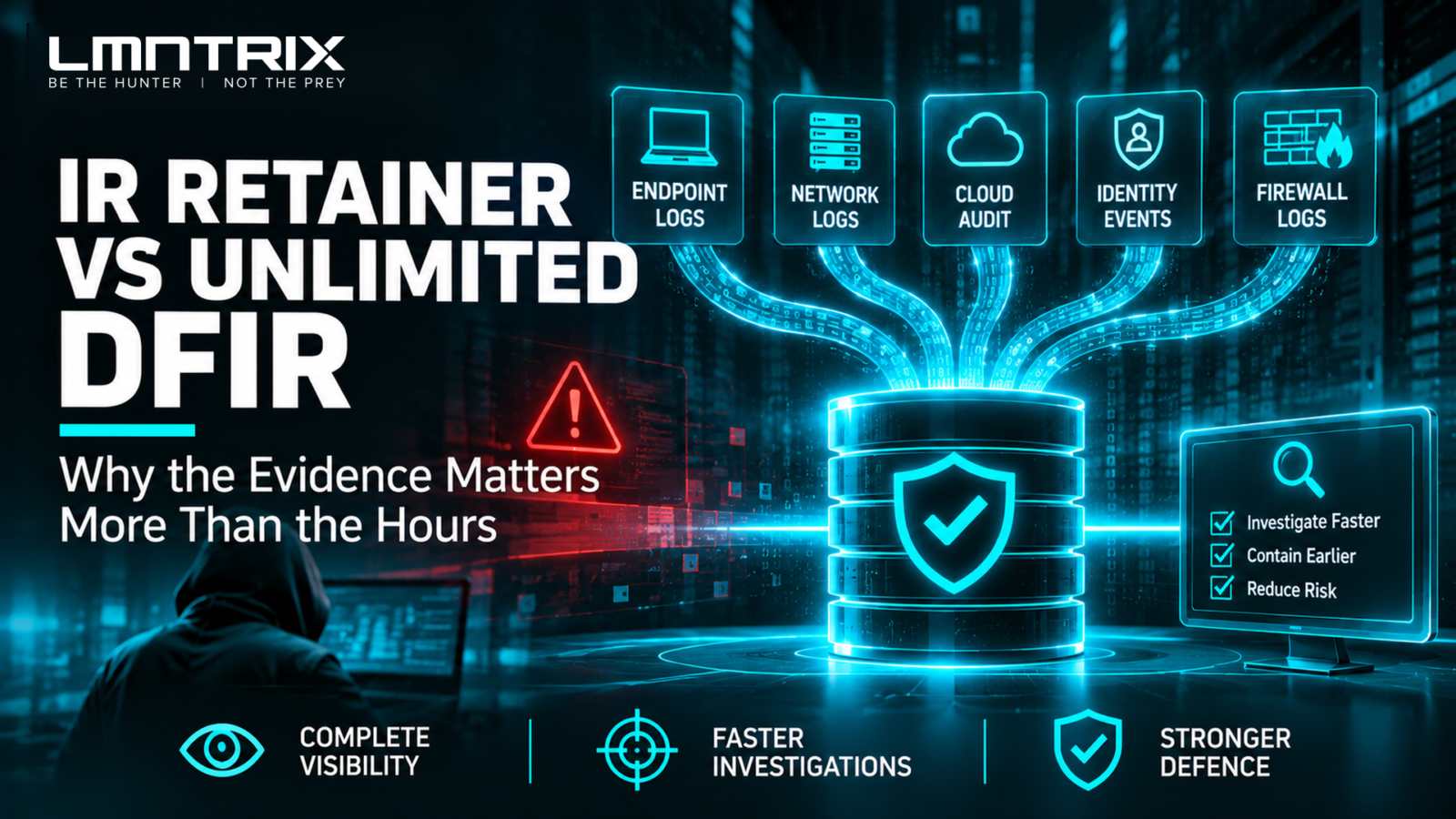
The call that goes wrong
It is 2:00 AM. Something is encrypting file shares. Someone finds the incident response retainer, calls the hotline, and a responder calls back within the hour, as the contract promised.
Then the responder asks the first question every investigation starts with: Can you send us the logs?
Which logs? From where? How far back? The firewall keeps seven days. The domain controllers overwrite their security log every few hours. Nobody turned on cloud audit logging for the subscription that was hit. The EDR keeps alerts, not telemetry. The responder is good, fast and expensive, and is now working blind.
This is the part of incident response nobody puts in the sales deck. A retainer buys you a person. It does not buy you the evidence that person needs.
The short answer: an incident response retainer is prepaid access to experts after something goes wrong, usually capped in hours and often lost if unused. MDR with unlimited DFIR, as LMNTRIX delivers it, is a team that is already collecting the evidence, already watching, and already responding, with forensics and incident response included and no hours to run out of.
How IR retainers actually work
Most retainers follow the same pattern. You prepay a block of hours or funds for a 12-month term, at a discounted rate. In return you get a hotline and a response-time commitment.
- Price tracks response time. One published model runs $25,000 to $74,999 a year for a 4-hour initial response, $75,000 to $149,999 for 2 hours, and $150,000 or more for 1 hour (LevelBlue).
- Hours are capped. Retainers typically include a block of roughly 40 to 200 hours a year (IR-OS guide). A serious ransomware investigation can burn through that in days, and overage is billed by the hour.
- Unused hours often expire. Some contracts say so plainly: in SentinelOne’s retainer addendum, unused IR hours expire at the end of the term and fees are nonrefundable (SentinelOne). Better providers let you convert unused hours into tabletop exercises or readiness work, but the money is still spent on preparing for incidents rather than handling them.
- The SLA is a phone call. A 1-hour or 4-hour SLA usually measures how fast someone starts talking to you, not how fast the attacker is stopped.
Even vendors who sell retainers describe the problem. One compares the classic retainer to a use-it-or-lose-it gym membership, where the only way the hours feel worth it is to have a crisis (LevelBlue).
So most organisations pay every year for a service they hope never to use. And when they do use it, they meet the bigger problem.
The evidence problem: responders can’t investigate what you never collected
An incident responder answers five questions: how did they get in, where did they go, what did they take, are they still here, and how long were they inside. Every one of those answers comes from evidence recorded before anyone knew there was an incident.
That evidence is usually missing. Denmark’s Centre for Cyber Security found that at least 75 percent of its operational cases were hampered by missing or insufficient logging, and that it is often forced to stop investigations because of it (CFCS, No Logs – No Crime). Where logging was turned on, the logs often covered only a very short timeframe.
The gaps are predictable:
- Retention is too short. Firewalls, domain controllers and local event logs roll over in days. Most intrusions are found weeks later.
- Logs are filtered out to save cost. Authentication and endpoint events get dropped from the SIEM as “too noisy”, then turn out to be the evidence.
- Cloud logging was never enabled. Audit, data-access and flow logs are often off by default, or on for some accounts and not others.
- There is no packet record. Logs say a connection happened. Only packets show what was sent, and whether data left.
- The attacker cleans up. An intruder with admin rights can clear the logs that do exist.
A retainer does nothing about any of this. The responder arrives after the evidence was or wasn’t collected. If it wasn’t, you are paying a premium hourly rate for an expert to tell you they can’t be sure.
That uncertainty has a cost beyond the investigation. Without evidence you can’t prove what data was or wasn’t taken, which shapes breach notifications, regulator conversations and insurance claims.
The fix is to stop waiting for the incident to start collecting. Assume the attacker is already inside, record the evidence every day, and plant traps that produce their own proof. A touched decoy records the attacker’s commands as they type them, which no log-wiping can undo. (For what that looks like in practice, see Is Deception Technology a Gimmick?)
Unlimited DFIR inside MDR: how LMNTRIX does it
LMNTRIX MDR includes unlimited digital forensics and incident response with every LMNTRIX XDR module. There is no retainer, no hours bank and no hourly clock. When an incident becomes a breach, the same team that detected it stays on it.
The difference that matters more than “unlimited” is that the evidence is already there:
- Endpoint telemetry is recorded continuously. The LMNTRIX agent records process, file, network, DNS, registry and driver activity, with 90 days searchable. Memory dumps and live response can be taken from the console.
- The network is recorded too. LMNTRIX Packets keeps full packets or session metadata for 30 days by default and up to 12 months. Sessions can be rebuilt and transferred files carved out.
- Logs are kept for a year. LMNTRIX SIEM holds 90 days online and a further 9 months in archive as standard, with parsers for new sources built at no extra cost.
- New intelligence is replayed against the past. When a new indicator is published, it is run against stored traffic automatically. “Were we hit before we knew?” gets an answer with the session as proof.
- Evidence is preserved properly. Forensic work keeps chain of custody to a standard that supports legal, regulatory and insurer requirements.
Response is also part of the service, not a referral. Containment on P1 incidents is guaranteed within 30 minutes of validation where response is pre-authorised. Containment and remediation are clocked separately and reported every month.
For ransomware, the datasheet commitment is specific: the host is isolated and the account disabled before encryption spreads, the entry point and lateral path are traced and closed, and the team stays engaged through restoration. You get the timeline, the affected-asset list and the recovery order.
IR retainer vs MDR with unlimited DFIR

Six questions to ask before you renew a retainer
Whether you keep a retainer, switch to MDR or run both, these questions show what you are really buying.
- If we called you tonight, what evidence would you have? Ask for the specific sources and how far back each one goes, not a general reassurance.
- Who collects that evidence before the incident, and who checks it is still being collected? A log source that silently stopped six months ago is the most common gap.
- How many hours does a typical ransomware investigation take, and what happens when ours run out? Get the overage rate in writing.
- What happens to the hours we don’t use? Expire, roll over or convert, and into what.
- Does your SLA measure the first call, or containment? They are different clocks.
- Who actually isolates the host and disables the account? If the answer is “your team, with our guidance”, that is your team working at 2:00 AM.
Frequently asked questions
Which MDR providers include unlimited DFIR? LMNTRIX includes unlimited digital forensics and incident response in its MDR service, with every LMNTRIX XDR module and no retainer. Evidence is collected continuously through endpoint telemetry, full packet capture and a year of log retention, so investigations start with data already in hand.
Is an incident response retainer worth it? A retainer buys guaranteed access to responders and a pre-agreed rate. Its value depends on hours you may not use and on evidence you may not have collected. If you already run MDR with unlimited DFIR, a separate retainer usually duplicates cost.
What happens to unused IR retainer hours? It depends on the contract. Some expire at the end of the term, and some convert to readiness work such as tabletop exercises. Either way, the hours are paid for in advance.
Do I need an IR retainer if I have MDR? Only if your MDR provider stops at detection or charges separately for forensics. With LMNTRIX MDR, incident response and forensics are included and unlimited.
Why do incident investigations fail? Most often because the evidence was never collected or was not kept long enough. Denmark’s Centre for Cyber Security found at least 75 percent of its cases were hampered by missing or insufficient logging.
What is the difference between an IR retainer and MDR? A retainer is on-call access to responders after an incident is suspected. MDR is continuous monitoring, detection and response. MDR with unlimited DFIR combines both, with the evidence collected before anything goes wrong.
Stop paying for the phone call
A retainer is insurance against the worst night of the year. It pays out in expert hours, after the fact, against whatever evidence happens to exist. Most years it pays out nothing.
LMNTRIX takes the opposite approach. Assume you are already compromised, collect the evidence every day, hunt for the attacker continuously, and include the forensics and response in the service. When the bad night comes, the investigation starts with a full record, and the team on the call already knows your environment.
Want to see what that record would show today? Every LMNTRIX engagement starts with a free 30-day proof of value in your own environment, including a compromise assessment and a written findings report you keep either way.