
Poisoned by a Trusted Script: What the Optimizely Compromise Teaches About Supply-Chain Exploitation, and How LMNTRIX Defends Against It
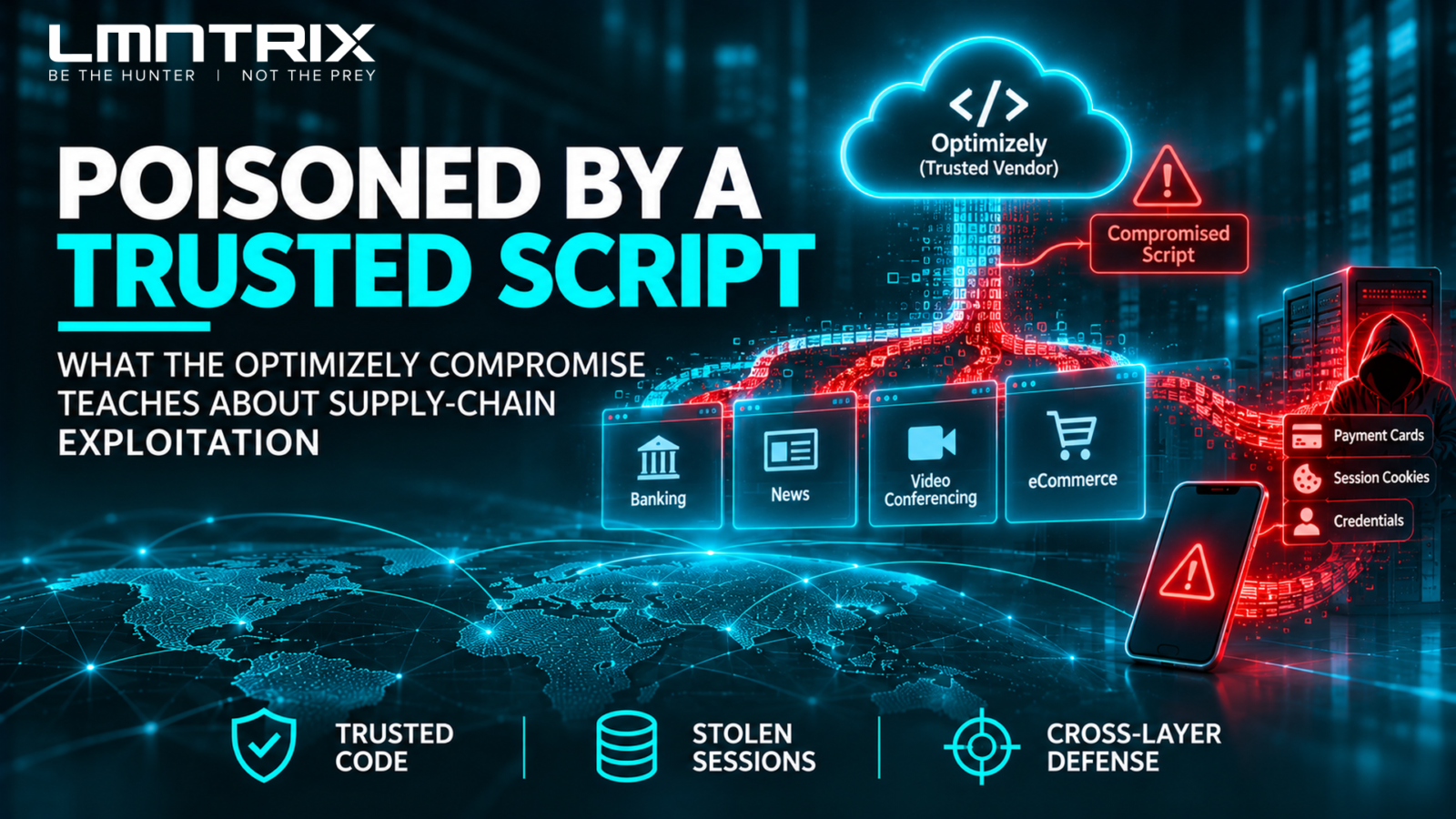
Summary: This week, visitors to some of the world’s busiest websites (the BBC, Zoom, HSBC UAE, GitLab and dozens more) ran malicious JavaScript. The sites had not been hacked. The code came from a vendor they trusted. It swapped cryptocurrency addresses, skimmed payment cards, stole cookies and screenshots, and sent iPhone and iPad visitors to the Coruna and DarkSword iOS exploit kits. Here is what happened, why it fits a wider 2026 pattern, and where an assume-breach defense catches what perimeter controls cannot.
What happened
Attackers abused a vulnerability in Optimizely Web Experimentation, a platform that companies use to A/B test and personalize their websites. That let them insert a loader into the Project JavaScript field, where customers place their own custom code. Every page that loaded the customer’s Optimizely snippet then ran the attacker’s code as well.
- Scale: Researchers found the code on 178 widely visited sites, 32 of them in finance or banking, plus technology, news, airline and retail platforms.
- Timeline: The code was first seen on Turkish websites in September. The latest wave ran on Monday 16 November.
- Vendor response: Optimizely confirmed on Monday evening that it had “identified and contained a security incident” affecting some Web Experimentation customers. It said the vulnerable path is blocked, the injected code has been removed, and affected customers have been contacted directly.
- Not only Optimizely: Independent researchers have noted the same payload served through Kissmetrics, StorifyMe and minute-ly. Their 21 named victims, including Salesforce, CNN, Fox News, Virgin Media O2, the Sydney Morning Herald and FAZ, are described as a documented subset, not a full count.
No operator has been identified, and nobody has established how the attackers gained access to the other three providers. Researchers have linked the delivery code to the same kit lineage as Coruna. That is a link between tools, not a named actor.
How the attack worked
The main payload, track.js (about 30 KB), bundles four functions into one script:

Two design choices make this campaign harder to clean up than an ordinary skimmer:
- Blocking the domain does not stop it. If the remote track.js fails to load or takes longer than 2.5 seconds, the loader runs a complete embedded copy of the payload (24 KB, Base64-encoded). The injected code has to be removed. Blocking the domain alone leaves it working.
- It removes itself. The minute-ly loader deletes its own script elements after three seconds. Anyone who inspects the finished page (the DOM) sees nothing. Only network captures show it.
One caveat: as researchers have noted, the iOS findings show that exploit delivery was observed in test scans. They do not prove that any iPhone was actually compromised, and researchers say they cannot yet estimate how many cards, cookies or devices were affected.
Why this goes beyond one vendor
The Optimizely case is the latest example of a pattern that became common in 2026: compromise a script that thousands of trusted sites already load, then use it to reach mobile devices that most security stacks cannot see.
- APT29 did the same thing weeks earlier. Researchers reported on 5 November that Russia’s APT29 (Cozy Bear) put malicious code into the tracking script of Plerdy, a Ukrainian web-analytics service, between late August and early September. That code reached visitors to hundreds of sites, including Ukrainian military and defense manufacturers. It fingerprinted each device, then used DarkSword on iOS 18.5, cookie theft on iOS 16, and old Chrome flaws on Android. Every vulnerability it exploited had already been patched.
- Spyware is now a criminal tool. Recent mobile threat research found that about 75% of criminal spyware detections involved Coruna or DarkSword, and researchers described 2026 as the year iOS spyware went mainstream. The same research estimates that an average Fortune 500 company sees about 65 mobile spyware infections a year, many of them on ordinary employees’ phones rather than executives’. Infected owners received no Apple threat notification.
- DarkSword is a watering-hole kit. Simply visiting a compromised page can be enough to infect a phone, with no link to click. That is exactly the delivery path that poisoned third-party scripts provide.
The lesson for security teams is uncomfortable. The malicious code arrived from a domain the site had approved, ran in a browser session, and in some cases targeted a phone with no endpoint agent. Most of the stack never had a chance to see it.
Where conventional controls miss it

How LMNTRIX is positioned to defend against it
LMNTRIX is built on an assume-breach model: sensors sit behind existing controls and work on the assumption that those controls have already been bypassed. A poisoned vendor script is that assumption in practice. The trusted layer is the attack vector. No provider can stop a third party from being compromised. What matters is how quickly the resulting activity is seen, connected into one picture and contained. Here is how each part of the LMNTRIX XDR platform and the MDR service, which is included with every module, applies.
1. Detect on the device being targeted: LMNTRIX Mobile
The iOS stage of this campaign targets the one device most enterprises cannot see. LMNTRIX Mobile runs on-device machine learning across iOS, Android and ChromeOS. It has no signatures, works offline, and covers more than 100 device threat types and seven phishing classifiers. It can be deployed to personal phones with an app and QR code, or with zero-touch enrollment through Intune or Workspace ONE. Recent mobile threat research shows that employees across the organization, not only executives, are being hit, so mobile coverage needs to extend to every employee’s phone.
2. Detect on the network: LMNTRIX NDR and Intelligence
When a corporate laptop or a phone on company Wi-Fi sends card data to card.php, requests a boot.js router or calls /api/gs_state, that traffic crosses the network. LMNTRIX NDR watches it passively from SPAN or TAP ports with ten detection engines, including web security and threat intelligence. With Active Directory context, each alert names a person rather than an IP address. LMNTRIX Intelligence draws on more than 300 sources, so newly published indicators like the ones below are added to detection as soon as they appear.
3. Answer “were we hit?” with evidence: LMNTRIX Packets and SIEM
This campaign ran for about two months before anyone disclosed it. That is the real problem: the indicators were published after the exposure. LMNTRIX Packets handles this through retrospection, replaying every new indicator against stored traffic (30 days by default, up to 12 months). The question “did any of our users reach 1688360[.]cc or the .icu boot hosts in October?” gets a proven answer within hours instead of a guess. LMNTRIX SIEM adds forensic log searches that return in under a second across 90 days of online data, for proxy, DNS and web-gateway records.
4. Shut down stolen sessions: LMNTRIX Identity and Recon
The payload’s purpose was to steal cookies, screenshots and credentials. Stolen sessions are typically reused or sold. LMNTRIX Identity watches for that reuse across seven identity platforms, including Entra ID, Okta, Microsoft 365 and Google Workspace, for example a session suddenly appearing from a new country. The Cyber Defense Center can disable the account and revoke its sessions through the platform’s API. LMNTRIX Recon Breach Intelligence monitors infostealer command-and-control logs for your employees’ credentials and session cookies, so leaked access is found before it is used.
5. Turn scattered signals into one incident: Artemis
In this campaign the evidence is scattered: a beacon from a laptop, a router request from an iPhone, and three days later an odd login from a stolen cookie. Separate tools would raise three separate alerts, if any. Artemis, LMNTRIX’s autonomous AI SOC, correlates signals across all 14 modules in the one data model (LMNTRIX Grid). It reconstructs the attacker’s path, scores the blast radius and drafts a containment plan within seconds. A human analyst then validates the incident and acts. Nothing is contained on a machine’s decision alone.
6. Respond on a clock, with evidence to show for it: LMNTRIX MDR
Researchers and incident responders give the same first advice: preserve evidence, then reconstruct which pages loaded the infected script, for how long, and which payments went through during that time. That is incident-response work, and it comes with LMNTRIX MDR:
- Unlimited DFIR, with no retainer and no hourly billing, and evidence preserved to legal, regulatory and insurer standards. This matters where PCI DSS scope and breach notification are at stake.
- Guaranteed clocks: P1 detection (MTTD) within 10 minutes and containment (MTTC) within 30 minutes where containment is pre-authorized, with containment carried out through the tools you already run.
- Continuous hunting: when a new campaign like this is disclosed, APT hunters search your environment for it without waiting for you to ask.
7. Test that you would catch it next time: LMNTRIX Validate
LMNTRIX Validate runs automated penetration tests that also grade your defenders: each attack step is matched to the alert it should have triggered. Simulating outbound data theft and beaconing to a new domain shows whether a skimmer’s traffic would have produced an alert, before the next vendor is compromised.
What to do now if your site loads third-party scripts
These steps combine the researchers’ recommendations with standard web-supply-chain practice. Some of them apply to your own web team and vendors rather than to any security service.
- Preserve evidence first. Save the script responses, hashes, headers, timestamps and project revisions before you restore anything.
- Remove the injected code and block the infrastructure. Blocking the domains alone leaves the embedded fallback running.
- Hunt across network logs, not page snapshots. Look for POSTs to card.php and hit.php, boot.js and entry-path requests, and calls to /api/gs_state or /api/pe_ok.
- Scope the exposure window. Work out whether payment, login or account pages loaded the affected scripts, and when. Invalidate exposed sessions where the evidence supports it.
- Patch mobile devices. The APT29 and DarkSword chains relied on vulnerabilities that had already been patched, and fully updated devices were not affected. Require a minimum iOS and Android version through MDM.
- Tighten third-party script governance. Keep an inventory of every vendor script, limit who can edit vendor projects (and require MFA), apply a strict Content Security Policy (CSP), use Subresource Integrity (SRI) where scripts are static, and keep vendor JavaScript off checkout and login pages wherever possible.
- Review the vendor’s publishing path. Check project changes, account activity, API credentials and integrations with each provider.
Indicators of compromise
From published researcher findings. Domains are defanged.

The takeaway
The Optimizely compromise was not a failure of one company’s website. It shows that trusted code is now part of the attack surface, and that the attackers using it are going after card data, sessions, crypto and the phones in employees’ pockets. Perimeter controls approved the vendor. What protects you is a defense that assumes the vendor has already been turned, and that watches the device, the network and the identity layer together.
Assume you’re already compromised. Take 30 days to find out. LMNTRIX’s free 30-day Proof of Value includes a compromise assessment of your environment and a written findings report that you keep whatever you decide.