
Main
- PlatformCore Detection & ResponseEDRAdvanced endpoint detection and response with deep visibility, autonomous containment, and analyst-driven investigationNDRNetwork detection and response powered by full packet capture, session reconstruction, and AI-driven anomaly detection.CloudUnified cloud protection across workloads, identities, and SaaS apps, combining visibility with runtime defense.MobileEndpoint security for iOS and Android, detecting malicious apps, phishing attempts, and device-level exploits.IoT/OTCritical asset visibility and threat detection for industrial and IoT environments—without downtime or blind spots.Human Threat Actor CoverageIntelligenceGlobal threat intelligence aggregated from 300+ sources, mapped to your environment for real-time detection and context.Attack ValidationAutomated adversarial validation to confirm detections, test controls, and prioritize real threats over noise.DeceiveDeception technology that lures attackers into decoy environments, revealing tactics before damage is done.IdentityIdentity threat detection and protection with real-time monitoring of Active Directory, Entra ID, and credentials.Post-Breach Forensics & IRPacketsFull-fidelity network forensics with packet capture, file extraction, and retrospective analysis.SIEMCentralized log management and correlation across all telemetry sources for complete security visibility.ReconContinuous adversarial exposure management—simulating attacker reconnaissance to surface hidden weaknesses.
- MDR
- Why LMNTRIX
Explore
- Active Defense
- Use CasesBusiness Use CasesReliable & Thorough CybersecurityElevate Security OperationsCross Product CorrelationTech Use CasesCloud Security SimplifiedOptimizing SIEM Security with Next-Gen Detection ToolsAchieve Excellence in Security OperationsComprehensive MITRE ATT&CK Coverage for All StagesEnvironment Use CasesMDR for AWS Cloud Security – 24/7 Detection & ResponseManaged Detection & Response for Google Cloud SecurityAdvanced Microsoft MDR Security for Threat Defense
- LMNTRIX vs the CompetitionLMNTRIX vs other vendorsvs. CrowdStrikeOverhyped, Overpriced & Always Breachedvs. SentinelOneLimited protection, unable to prevent breachesvs. MicrosoftComplex operations increase TCOvs. Palo Alto NetworksDifficult to implement, operate, & maintainvs. SophosOverpriced and Overcomplicatedvs. Trend MicroLimited to own ecosystem & threat of DevOps interruptionsvs. DarktraceOver-promises with flashy AI marketing but always under-deliversvs. other MDRsSlow MDRs that miss threats and leave you to fix the damage
- Ask LISA
Back to Resource Center
Infographics
How to become a CISO what a F100 ciso looks like
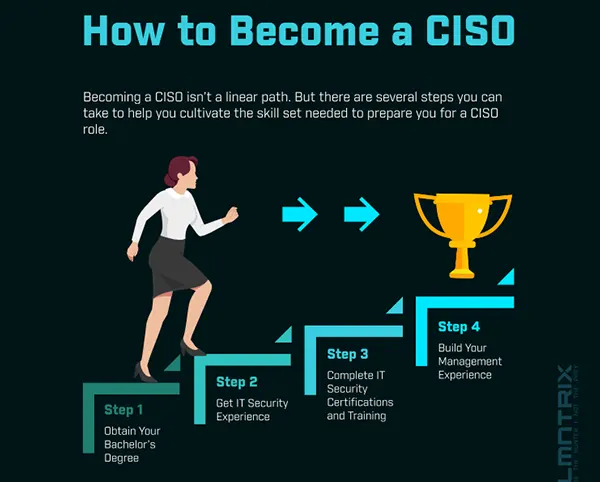
The chief information security officer (CISO) is the executive responsible for an organization's information and data security. While in the past the role has been rather narrowly defined along those lines, these days the title is often used interchangeably with CSO and VP of security, indicating a more expansive role in the organization.
Ambitious security pros looking to climb the corporate latter may have a CISO position in their sights. Using this fun infographic, let's take a look at what you can do to improve your chances of snagging a CISO job, and what your duties will entail if you land this critical role. And if you're looking to add a CISO to your organization's roster, perhaps for the first time, you'll want to view this as well.