
Are AI SOC Agents Overhyped? A Practitioner’s View of the 2026 Agentic SOC Boom
The short answer
At LMNTRIX, where our Cyber Defense Centers run an AI SOC around the clock, our answer is: partly. AI SOC agents are not overhyped at investigation. They are overhyped at judgement. They can read every alert, join the evidence and rebuild an attack path faster than any analyst. What they cannot yet do reliably is decide, on their own, to cut off a business system.
That distinction matters more this month than it did last month. In November 2026, Google, Amazon and the FBI all reported attackers running autonomous AI agents in live intrusions. The vendor pitch says the answer is to fight agents with agents. The better answer is to put defensive AI where it is strong, and keep accountable people where the cost of being wrong is high.
This piece is written from the analyst’s chair. It covers what changed, where AI SOC agents earn their place, where the hype runs ahead, and the questions to ask any vendor before you sign.
What changed in 2026: both sides now run agents
Two trends met this year. Defenders bought AI SOC agents in large numbers, and attackers started running agents of their own.
On the defensive side, Gartner’s Hype Cycle for Security Operations, 2026 moved AI SOC agents from the Innovation Trigger to the Peak of Inflated Expectations in one year. A separate Gartner report predicts that by 2028, 70% of large SOCs will pilot AI agents for Tier 1 and Tier 2 work. It also predicts that only 15% will see measurable gains without structured evaluation (Help Net Security).
On the attack side, November brought the clearest evidence yet:
- 16 Nov: Google’s Threat Intelligence Group said attackers had moved beyond manual prompting to multi-agent offensive frameworks such as ARTEX, CAIRN, CyberStrikeAI and PentAGI. They also use AI to reverse-engineer patches into exploits (The Hacker News).
- 16 Nov: The FBI and Amazon warned that ARTEX shortens the time needed to chain attack techniques, with some intrusions reaching privileged access in under three hours (The Register).
- 20 Nov: Amazon’s CISO described suspected China-linked agents that found a zero-day in an open-source medical imaging app. They could write files on the target server about 11 minutes after mapping its API (The Register).
The same Amazon case shows the other side of agents. They spent about 16 hours and 148 actions failing to break into one Redis server. Attacker agents are fast and tireless, but they also flail. Defender agents share both traits, and that is the honest starting point for any AI SOC discussion.
Where AI SOC agents genuinely deliver
The hype is earned in four places. In each, speed and breadth matter more than judgement, and a wrong answer is cheap to catch.
- Triage at volume. An agent can open every alert, not a sample. At LMNTRIX, automated validation plus supervised machine learning cuts the alerts that reach a client by 95%, with a false-positive rate of 5% or less.
- Correlation across tools. Agents join an endpoint process, a network flow, an identity sign-in and an email click into one story. Our AI SOC, Artemis, does this across all 14 modules of the LMNTRIX XDR platform.
- Rebuilding the attack path. Artemis reconstructs the attacker’s route, scores the blast radius and drafts a containment plan in seconds. That is work a Tier 2 analyst would spend an hour on.
- Answering questions in plain language. Analysts and clients can ask LISA, our ChatOps assistant, what happened on a host from the console, Slack or Teams. It answers from the client’s own telemetry.
Against agentic attackers, this speed is not optional. If an intrusion can reach privileged access in under three hours, a SOC that takes a day to correlate is already too late.
Where the hype runs ahead
The pitch goes wrong when “autonomous” moves from investigation to action. Four failure modes show up in practice.
Agents lose the thread on long tasks. The International AI Safety Report 2026 found that agents issue irrelevant commands, lose track of where they are in an operation, and fail to recover from simple errors without a person (TechInformed). That research was about attacker agents. Nothing about it changes when the agent works for the defender.
Confident and wrong is expensive. An agent that wrongly isolates a payment server or disables a CFO’s account during quarter close costs real money. A human who makes that call can explain it, defend it and reverse it. An agent’s audit trail often cannot.
Agents can be steered. A defender agent reads attacker-controlled data all day: email bodies, file names, web pages, log lines. Prompt injection hidden in that data can push an autonomous agent toward the wrong conclusion, or toward closing the alert the attacker wanted closed. The same risk applies to the AI agents your own business runs. The LMNTRIX AI Security Datasheet shows how runtime guardrails screen prompts, tool calls and tool responses for injection before an agent acts.
Pilot numbers are not production numbers. Gartner’s 15% figure is the clearest warning. Many AI SOC claims come from a proof of concept on clean data, not a year of production noise. Ask which one you are looking at.
None of this means AI SOC agents fail. It means the vendors promising to “remove the human” are selling the one part of the job agents do worst.
The model that works: AI investigates, people decide
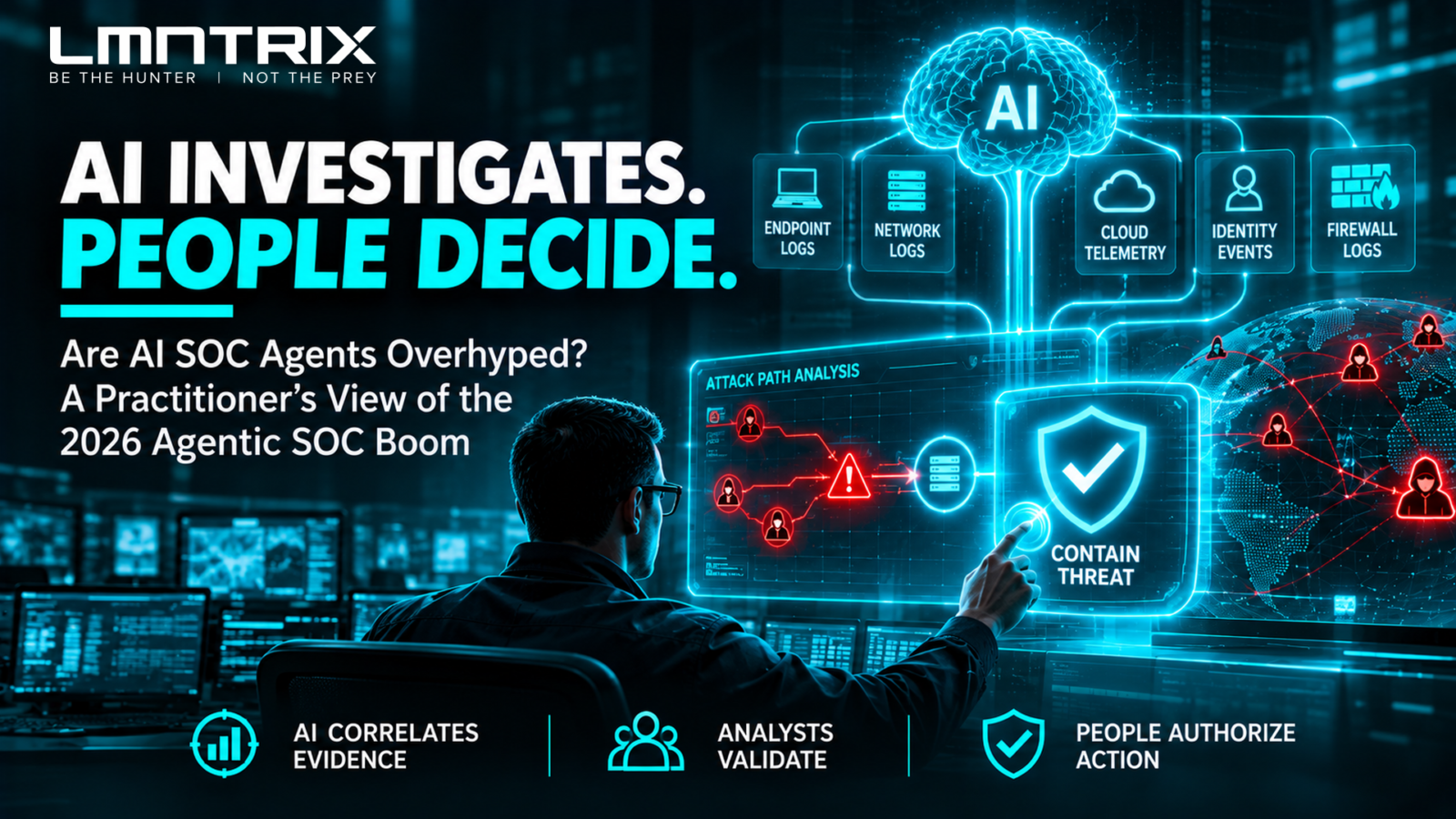
The answer is not fewer humans or fewer agents. It is a clear line between them. At LMNTRIX, Artemis does the investigation and our analysts own the decision. Nothing is contained on a machine’s say-so alone.
An incident moves through five steps:
- Detect. A signal fires in any of the 14 modules, from endpoint to identity to deception decoys.
- Investigate. Artemis correlates the evidence, rebuilds the attacker path, scores blast radius and drafts containment, in seconds.
- Validate. An analyst in one of our Cyber Defense Centers, across seven countries, checks the work. 100% of incidents are reviewed by a person before closure.
- Contain. The analyst acts through the client’s own controls, such as CrowdStrike, Defender, SentinelOne or the firewall.
- Report. The client sees the attack chain, the action taken and the evidence.
The human step does not have to be slow. Our MDR service guarantees a P1 incident reaches an analyst within 15 minutes and, where the action is pre-authorised, is contained within 30 minutes of validation. Speed comes from the agent. Accountability comes from the person, and from a contract.
Clients also choose how much authority we hold, per asset group: full response (we act, then tell you), co-managed (we propose, you approve) or notify-only. That is the “widen autonomy gradually” approach Gartner recommends, built into the service rather than left to the buyer.
Agentic attackers make this model stronger, not weaker. An agent that flails for 16 hours against one server is noisy. Deception decoys and identity traps catch that noise, Artemis connects it, and a person decides what to shut down.
Seven questions to ask any AI SOC vendor
Use these to separate a working AI SOC from a demo. The right column is how LMNTRIX answers, so you have a benchmark.

The verdict
AI SOC agents are worth buying for investigation, and overhyped as a replacement for judgement. Attackers getting agents this month does not change that. It raises the price of a wrong call, which is the strongest argument yet for a person on the containment decision.
If you want to see where your own SOC sits, LMNTRIX offers a free 30-day Proof of Value with the full MDR service. Artemis and our analysts hunt your environment, and you keep the written findings report either way. Assume you’re already compromised. Take 30 days to find out.
FAQ
Are AI SOC agents overhyped? Partly. Gartner’s Hype Cycle for Security Operations, 2026 places AI SOC agents at the Peak of Inflated Expectations. They deliver real gains in triage, correlation and investigation speed. Claims that they can safely replace human decision-making on containment run ahead of the evidence.
Is autonomous AI security better than human-led threat detection? Neither alone is best. AI is faster and more thorough at reading alerts. Humans are better at judging business impact and owning the decision. LMNTRIX combines both: Artemis investigates every incident, and an analyst reviews 100% of them.
Are attackers really using AI agents? Yes. In November 2026, Google, Amazon and the FBI each reported attackers using autonomous agent frameworks such as ARTEX and CAIRN in live intrusions, including one that exploited a zero-day.
What is human-in-the-loop in an AI SOC? It means a person approves consequential actions, such as isolating a host or disabling an account, before they happen. Human-on-the-loop means a person supervises but does not approve each action. LMNTRIX lets clients choose per asset group.
How fast can a human-validated SOC respond? At LMNTRIX, a P1 incident is guaranteed to reach an analyst within 15 minutes, and contained within 30 minutes of validation where the action is pre-authorised.